BLS Certification Study Guide for Skills Day
Use this BLS certification study guide to prepare for CPR, AED use, ventilation, and skills testing with a clear, practical plan for healthcare learners.
A BLS certification study guide should help you do more than remember a compression rate or pass a written test. In a real emergency, you must recognize that a patient is unresponsive, call for help, begin high-quality CPR, use an AED safely, and communicate clearly with the team. The goal is to make those actions organized and repeatable before you are standing at a bedside, in a clinic, or responding in the field.
For healthcare students and renewing providers, the most common challenge is not a lack of effort. It is trying to memorize isolated facts without practicing the sequence of care. BLS works best when you study the clinical priorities, then connect them to hands-on performance.
Start With the BLS Chain of Response
BLS begins with recognition. Before placing your hands on the chest, make sure the scene is safe, check for responsiveness, and call for help. If you are in a healthcare setting, activate the emergency response system and send someone for the AED or crash cart. If you are alone, follow your workplace protocol while getting emergency assistance and an AED as quickly as possible.
Next, assess breathing and pulse at the same time. This check should take no more than 10 seconds. Agonal gasps are not normal breathing. If an adult, child, or infant has no pulse or no normal breathing, begin CPR immediately. If there is a pulse but breathing is absent or inadequate, the patient needs ventilatory support rather than chest compressions.
That distinction matters. Students sometimes rush into compressions because they know cardiac arrest is serious. Effective BLS also requires knowing when the problem is primarily respiratory, such as opioid-related respiratory depression, drowning, or a pediatric event. A calm, timely assessment helps the team choose the correct intervention.
Study High-Quality CPR Before Memorizing Details
High-quality CPR is the center of BLS. The numbers matter, but they only work when paired with good technique. For adults, compress at a rate of 100 to 120 compressions per minute and a depth of at least 2 inches while avoiding excessive depth. Allow full chest recoil after each compression and keep interruptions as short as possible.
For children and infants, compress about one-third the depth of the chest. This is approximately 2 inches for a child and 1.5 inches for an infant. Use the technique appropriate to the patient’s size and the number of rescuers available. For an infant, the two-thumb encircling technique is generally preferred when two trained rescuers are present because it supports consistent depth and recoil.
Your BLS certification study guide should also include the compression-to-ventilation ratios. A single rescuer uses 30 compressions to 2 breaths for adults, children, and infants. With two trained rescuers for children and infants, the ratio changes to 15 compressions to 2 breaths. These are easy facts to review, but the larger priority is minimizing pauses. Long breaks before or after breaths reduce the blood flow CPR is intended to provide.
Practice saying the key actions out loud as you perform them: “Checking responsiveness. Calling for help. No normal breathing, no pulse. Starting compressions.” Verbalizing the sequence helps during a skills evaluation and strengthens closed-loop communication in clinical practice.
Know How to Deliver Effective Ventilations
Ventilation is often where learners lose confidence. A proper breath lasts about one second and should produce visible chest rise. Too much volume or pressure can force air into the stomach, increase aspiration risk, and make ventilation less effective. Focus on a good mask seal, airway positioning, and controlled breaths.
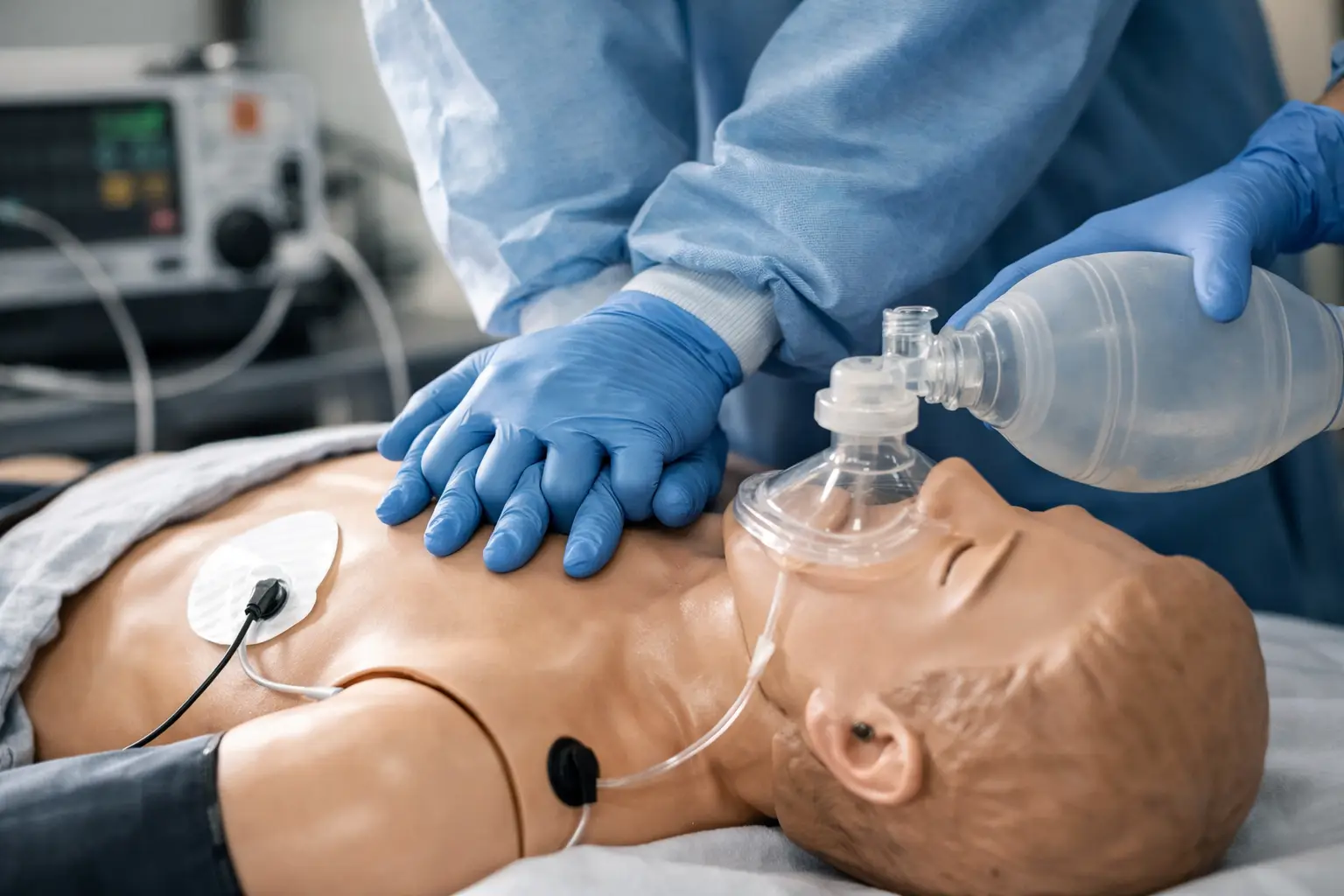
For one-rescuer mouth-to-mask ventilation, position the airway appropriately and watch the chest, not just the equipment. With a bag-mask device, two trained providers can usually ventilate more effectively than one. One provider maintains the mask seal with both hands while the second squeezes the bag. This is especially helpful for infants, children, and patients with difficult facial anatomy.
If an advanced airway is in place during resuscitation, compressions continue without pausing for breaths. Ventilate at the appropriate rate for the patient population and avoid overventilation. Your course instructor will evaluate the exact skill sequence required for your certification program, so use your assigned course materials as the final reference.
Treat the AED as an Early Priority
An AED is not something to wait for after several CPR cycles. Send for it as soon as cardiac arrest is recognized, and use it as soon as it arrives. Continue compressions while pads are being placed whenever possible.
Before analysis, make sure no one is touching the patient. State the safety check clearly: “Clear.” If a shock is advised, confirm the area is clear again, deliver the shock, and resume compressions immediately. Do not pause to check a pulse right after a shock unless the device or clinical condition directs you to do so.
Study common AED safety situations as well. Dry a wet chest quickly, remove medication patches when they interfere with pad placement, and place pads so they do not sit directly over an implanted device. For pediatric patients, use pediatric pads or an energy attenuator when available, but do not delay defibrillation if only adult pads are available. Place them so they do not touch.
Prepare for Team-Based Skills Testing
In a healthcare setting, BLS is rarely a one-person task. Skills testing often evaluates whether you can work within a coordinated response. One rescuer performs compressions, another manages the bag-mask device, and another operates the AED. Roles should be clear, and rescuers should switch compressors about every two minutes or sooner if fatigue affects compression quality.
Closed-loop communication prevents missed steps. Rather than saying “Someone get the AED,” assign a name or role: “You, bring the AED.” The receiving provider repeats the request and confirms completion. This sounds simple, but it is a practical patient-safety habit that carries into ACLS, PALS, trauma care, and daily clinical work.
Do not study BLS as a script that cannot change. The core sequence remains organized, but patient age, the number of rescuers, available equipment, and the presence of a pulse affect what happens next. Your job is to recognize those differences without losing the basic priorities of oxygenation, circulation, defibrillation, and effective communication.
A Practical Study Plan for BLS Certification
Start several days before class rather than reviewing everything the night before. Read the assigned provider material once for the overall sequence. On your second review, focus on the points that require a decision: no pulse versus pulse present, one rescuer versus two rescuers, adult versus pediatric patient, and when to use the AED.
Then practice physically. Use a manikin if you have access to one, or rehearse body position and verbal steps without equipment. Count compressions aloud, practice switching roles, and simulate opening an AED and placing pads. Watching a demonstration can reinforce the sequence, but hands-on repetition is what exposes weak spots such as incomplete recoil, poor hand placement, or hesitation during a safety check.
The evening before class, review your course instructions, bring required identification or completion documentation, and arrive ready to participate. Wear clothing that allows you to kneel and perform compressions comfortably. If you are renewing, do not assume prior experience will carry you through the skills check. Guidelines, equipment, and assessment standards can change, and technique can drift over time.
When You Need More Than a Study Guide
A study guide supports preparation, but it cannot replace instructor feedback. Small corrections in compression depth, hand placement, mask seal, and team communication can make a major difference in performance. This is particularly valuable for CNA and Medical Assistant students building their first patient-safety foundation, as well as for experienced RNs, LVNs, EMTs, and other providers renewing required credentials.
Central Valley Medical Education provides hands-on BLS training for healthcare learners who need clear instruction, practical skills practice, and confidence using emergency equipment. Not sure which course you need? Call or text CVME at 559-765-0306 and we’ll help you choose the appropriate training.
Bring your questions to class, practice the sequence until it feels organized, and treat every BLS skill as preparation for the moment a patient needs you to act without delay.


